


Encircle Technologies is an IT company specialising in the Web and Mobile app development services for all types of businesses; small or large, for all business verticals, across the world. We’re proud to say that our team has worked with some truly incredible partners over a short period of time.

- /
- Blog
- /
- List of Business Automation Services: What to Automate First

Summarize this blog post with:
Business automation uses technology to automate repetitive workflows, which include lead management, invoicing, and customer communication tasks that require no human intervention. The business automation services enable automatic execution of tasks through predefined rules, which activate the system to start its operations. This reduces the need for manual work while it enhances precision and maintains operational efficiency, which enables teams to concentrate on strategic decisions and business expansion instead of handling standard administrative work.
Business automation enables organizations to automate their standard operations through technological solutions that require no human monitoring and no additional monetary costs. This means teams can rely on automation to send email transactions, keep records, or manage tasks. Tell the automation how to do each task, and it gets done. The automation system works around the clock, improving other parts of the business to be more strategically focused.
The current business world requires automation because its operational speed has undergone significant changes. The current business environment requires companies to respond to customer needs faster, while their teams have to complete additional work with fewer available resources, and their competitors are now more challenging to overcome than ever.
Research shows that approximately 60% of jobs contain more than 30% of their tasks that can be automated, thus demonstrating the potential time savings for companies. The study found that 88% of small business owners think automation enables them to compete better against large businesses, which shows its powerful effect on their business growth and market position.
The blog demonstrates how business automation works and its significance while guiding which business processes should be automated first to achieve efficiency gains and sustainable business growth.
Understanding Business Automation and How It Works
➥ Definition in simple terms
Business automation uses technology to perform defined work activities through established procedures, which decreases the need for human workers during routine business functions. The business automation services handle all business functions by executing data entry, communication, and reporting processes through automated systems, which maintain operational standards while delivering faster results and better control of business operations.
➥ Real-world examples
Real-world examples show that retail companies can use their systems to send order confirmations and update inventory systems while they automatically create delivery notifications after customers complete their purchases. Workflow automation services enable businesses to distribute leads and plan follow-up activities while they monitor customer interactions in real time, which helps them to prevent any lost business opportunities and provide an uninterrupted customer experience.
➥ Difference between automation and AI
Automation uses established rules to complete specific tasks, but AI develops its capabilities through data analysis and pattern recognition to create adaptive solutions. A business process automation company typically builds rule-based workflows, whereas AI-driven systems enhance those workflows by predicting outcomes, optimizing performance, and enabling smarter decision-making beyond simple task execution.

Why Business Automation Is Essential for Growth
✦ Saves time and reduces manual work
Hours are usually spent switching between tools to update records and keep up with routine follow-ups. These tasks are tedious and add no value. With business automation services, companies can get rid of these tasks and design workflows that move things along more easily and keep operations running without needing manual input again and again.
✦ Minimizes human error
Even the most seasoned teams make mistakes, especially with repetitive processes done under time pressure. Operational issues can arise from things like missing an entry, putting in the wrong figure, or an update that is pushed out too late. With automation, all the processes are done in a structured and well-defined way, resulting in a better experience with fewer inconsistencies.
✦ Improves productivity and consistency
A lot of repetitive, manual tasks result in unreliable, inconsistent work and hurt performance and execution speed across teams. When processes are automated, employees don’t have to worry about whether they did it right because of the set standard. Everyone can expect to deliver a tighter and more organized workflow reward. Automation processes can result in more organized work, predictable outcomes, and swift turnaround.
✦ Enhances customer experience
More than ever, customer timely and reliable communications are critical. If you respond to customers late, don’t follow up, and give inconsistent messages, they are less likely to recommend you to others. Automation means set-standard processes to remind you about that follow-up, to confirm that they’ve received what they requested, or to close the case. When you respond promptly, they can trust you.
✦ Supports scalable growth
Growth exposes operational inefficiencies that organizations could have controlled during their previous, smaller operational periods. Manual processes face challenges when demand expands because they cannot handle the increased workload. Businesses can expand their operations because automation establishes a consistent working environment, which enables them to manage increased production without workflow interruptions or team overloads.
Also Read: Top AI Automation Company in India for Business Process Automation
List of Business Automation Services

➤ Marketing Automation
» Email marketing automation
Email marketing automation allows businesses to send customized messages to users based on their behavior, their personal preferences, and their current stage in the user journey. The system operates as an automated solution that conducts campaigns through scheduled outreach to deliver messages at the right time, which helps to increase user interaction while maintaining consistent brand communication that supports larger business objectives through business process automation services.
» Social media scheduling
The process of manually handling multiple platforms results in inconsistent content distribution and lost chances to post. Automation tools will schedule and post content at the right time, enabling brands to keep up an online presence without the need for continuous maintenance. The system delivers continuous audience interaction while decreasing the time needed for effective daily social media management.
» Lead nurturing workflows
The process of converting leads requires ongoing follow-up efforts because not all leads will convert on their first contact with the business. The automated workflows enable businesses to guide their prospects through the sales funnel while providing appropriate content and maintaining scheduled contact with their leads. This establishes trust with prospective customers who remain engaged throughout the process, which results in increased chances of conversion because it eliminates the need for manual tracking at each point of the system.
» Ad campaign automation
To achieve effective results in digital advertising, advertisers must execute ongoing changes to their campaigns. The automated systems handle bidding management, audience targeting, and performance assessment according to current conditions. This enables campaigns to adapt to new information, which results in better investment returns and decreases the need for ongoing manual campaign monitoring and optimization efforts.
➤ Sales Automation
» CRM systems
CRM systems centralize all customer information in one location, which enables businesses to track customer interactions and handle their relationships while accessing information instantaneously. The automated updates maintain record accuracy, enabling sales teams to work efficiently while making informed decisions without needing to spend time on data entry and data retrieval tasks.
» Lead scoring
The system performs automated lead scoring by analyzing prospect behavior, together with their engagement level and their fulfillment of established requirements. This enables sales teams to concentrate their efforts on high-potential leads instead of dedicating time to leads that do not meet their qualifications. The system improves resource allocation and establishes better lead evaluation methods, which result in higher conversion success rates.
» Follow-up reminders
Sales process requires timely follow-ups because they serve as essential components of the sales process. Automation creates reminders that activate when customers take specific actions or when designated time periods end. The system helps sales teams maintain their communication schedule while using automated reminders to track customer progress in the sales process.
» Pipeline tracking
Sales pipelines become unmanageable when organizations lack effective monitoring systems. This uses automation to deliver immediate updates about deal stages, their current status, and existing obstacles. This provides teams with the ability to detect problems at an early stage, which enables them to modify their plans while sustaining a consistent stream of sales opportunities throughout the entire sales process.
⮞ Customer Support Automation
» Chatbots
Chatbots provide immediate answers to common customer questions, which helps reduce their response times while decreasing the workload of support staff. The system functions continuously throughout the day to deliver standard answers while gathering basic data, which enables human agents to work on complicated cases that demand advanced knowledge and individualized solutions.
» Helpdesk ticketing systems
The ticketing systems organize and distribute customer requests to the appropriate personnel while assigning them priority based on their urgency and request type. The system provides a structured method that helps organizations to resolve customer inquiries more quickly while preventing any missed requests. By utilizing custom business automation services, businesses can enhance their support operations without losing track of their current and past customer engagements.
» FAQ automation
Automated FAQ systems deliver instant answers to frequently asked questions, which decreases the need for human support. Businesses can design their knowledge bases through proper structuring to enable customers to solve their problems by themselves, which enhances operational performance while delivering precise information during all user interactions.
» Self-service portals
Self-service portals enable customers to handle their account operations and monitor their requests, which they can resolve without needing any assistance. The system decreases support demands while it improves user satisfaction through its ability to deliver quick solutions for ordinary customer inquiries and service requests.
➤ Finance & Accounting Automation
» Invoicing and billing
Automated invoicing systems generate and send bills instantly based on transactions or predefined schedules. The system eliminates delays and enhances cash flow while removing all manual mistakes. The organization achieves precise billing results through its consistent billing system, which also decreases the time needed for repetitive financial tasks.
» Expense tracking
The system uses automated expense tracking to record expenses and create spending reports, which are processed in real time. It reduces the need for manual work while reducing errors. Businesses gain a better understanding of their finances, which helps them control expenses, manage their budgetary requirements, and maintain accurate records for reporting and compliance.
» Payroll processing
Payroll automation enables businesses to calculate employee salaries through automatic systems that process salary deductions, taxes, and benefits. The system decreases administrative tasks while it protects against errors that might lead to employee dissatisfaction. The established system maintains financial regulation compliance while it streamlines intricate payroll administration procedures.
» Financial reporting
The automated financial reporting tools create accurate reports through their ability to gather data from various sources. The system provides immediate business performance insights because it eliminates the need for manual calculations, which enables decision-makers to react to financial trends and make strategic decisions based on actual business performance.
➤ HR Automation
» Recruitment workflows
Recruitment automation process helps streamline candidate sourcing, candidate screening, and interview scheduling. The system establishes a standard recruitment process that operates without requiring any manual coordination efforts. The solution permits HR teams to concentrate on talent assessment and improved hiring decisions while they handle the essential administrative work that occurs during the recruitment process.
» Employee onboarding
The onboarding process uses automated systems to deliver essential documents and training resources and system access to new employees without any waiting period. The structured process that organizations use to onboard new employees creates an efficient experience for workers while decreasing the need for manual work coordination. The program establishes an early engagement connection, which helps new employees reach their productivity peak faster.
» Attendance tracking
The automated attendance system records employee work hours, leave periods, and shift schedules with complete accuracy. The system eliminates the requirement of manual attendance tracking while decreasing errors. It enables organizations to observe their workforce availability in real time, which allows them to create schedules and sustain their business operations.
» Performance management
Performance management automates, tracks goals, generates performance evaluations, and provides assessment feedback in an organized manner. The system maintains uniformity in evaluation processes while it delivers explicit information about employee advancement. Organizations can use these insights to support development, improve productivity, and align individual performance with overall business objectives.
➤ Operations & Workflow Automation
» Task management tools
Task management tools execute automation to manage task assignments and execution tracking through predefined trigger-based systems. The implementation of professional services automation for small businesses enables companies to optimize their daily operations while maintaining employee responsibility and tracking work progress without needing continuous status updates.
» Project workflows
Automated project workflows direct teams to proceed through project phases because their work depends on the completion of previous tasks. The system increases operational efficiency by decreasing project delays and enhancing communication between different teams while maintaining project schedules through automatic processes.
» Approval processes
Approval workflows send requests to their correct stakeholders through automatic routing, which follows established rules. It streamlines decision processes by removing manual approval bottlenecks. The system ensures all necessary verification procedures occur through orderly methods that produce complete documentation.
» Inventory management
Managing inventory operations through automated systems enables businesses to monitor product quantities in their inventory. The system automatically handles stock management by deducing ideal product levels to maintain operational flow between different stages of supply chain maintenance.
➤ IT & Security Automation
» Data backups
Automated backups save business info at regular intervals without manual input. This eliminates the chance of losing data. Lost data can otherwise be restored quickly in case of system failures or emergencies.
» Software updates
Software updates can capture system updates and apply them where they are needed without manual input. Automation takes away the necessity of tracking updates and saves employees more time to work on other parts of the business.
» Security monitoring
Security Automation streamlines unusual activity detection, threat identification, and alerts and responses to level up system protection. This multi-layered approach minimizes security breaches by maintaining the integrity of system operations beyond just security oversight.
» User access management
User Access Automation reduces the risk of information exposure by assigning controls based on workplace roles. Full system access is then moderated by managing and maintaining the removal and reassignment of access for compliance with business data to limit exposure.
➤ CRM Data Management Automation
» Automatic contact updates
CRM automation allows teams to have an up-to-date contact list since customer data is updated automatically from external sources and tasks. Contacts won’t be out-of-date, and team communications about contacts will be current.
» Lead enrichment from external sources
Automation improves contact with additional data from outside sources. The system enables businesses to analyze customer requirements, which leads to the development of customized communication methods that do not require manual lead investigations.
» Duplicate data cleanup
Duplicated records can interfere with your workflow and cause disarray and a lack of cohesion among teams. Automated systems will track and combine duplicate records, keeping data organized and cohesion intact. This increases the accuracy of your data and helps you communicate with your customers without confusion and overlap.
» Customer segmentation updates
With automation of systems, your customer segments will be continuously and automatically updated with the changes in behavior, preference, and engagement. This means that marketing and sales efforts will be able to reach the right and most relevant audience without needing the segmentation to be manually updated.
➤ Feedback & Survey Automation
» Automated NPS surveys
Automated NPS Survey technology enables businesses to gather real-time feedback through customer survey distribution at crucial touchpoints, all without the hassle of initiating a survey manually. With a workflow automation consultant’s guidance, companies can effectively pinpoint corrective actions and swiftly detect potential enhancement areas.
» Post-purchase feedback collection
Automated post-purchase review requests are sent shortly after a transaction, and businesses can capture feedback precisely by doing so. Understanding and managing customer expectations, recognizing service and offering shortcomings, and aligning responses to customer feedback are enhanced.
» Review request workflows
Automated review processes activate customer satisfaction reviews, which customers submit to specified online platforms. Businesses that send requests during appropriate times will receive more positive reviews and establish stronger trustworthiness, which helps them build a better online reputation.
» Sentiment analysis reporting
Sentiment analysis automation processes customer feedback data to discover patterns in customer opinions. The system categorizes responses into three categories, which include positive, negative, and neutral, to assist businesses in understanding their customers’ perception patterns for better decision-making that will enhance customer satisfaction.
➤ Business Intelligence Automation
» Automated KPI tracking
Automated KPI tracking monitors performance metrics in real-time across all systems. With local business process automation services, organizations can accurately automate data flows, enabling them to make quicker decisions without manual tracking and reporting delays.
» Executive summary reports
Automation goes a step further and compiles business data into concise reports, eliminating the need to write them manually. This enables leadership to gain insights into performance, trends, and challenges, and to focus on high-impact activities such as strategic decisions, rather than spending inordinate amounts of time collating and structuring the data.
» Predictive analytics dashboards
The predictive dashboards create future trend forecasts by analyzing past data, which assists businesses with their planning activities. The system uses automated processes to refresh the information continuously, which allows teams to forecast demand and spot potential dangers while they base their decisions on trustworthy data.
» Data integration from multiple tools
Automation of data integration processes creates connections between various platforms, which enables continuous data sharing between different systems. It removes data silos while enhancing accuracy and delivering an integrated operational overview that enables businesses to assess performance without doing manual data aggregation from various sources.
Top Business Processes You Should Automate First
✤ Email responses and follow-ups
Email responses and follow-ups work through automated systems, which deliver messages on time without requiring any manual work. The system enables automatic follow-up execution when users perform specific actions, which helps to maintain contact with potential customers while creating a steady outreach pattern that prevents sales or support interactions from being lost.
✤ Lead capture and CRM updates
The system automatically captures leads through form, advertisement, and website data, which it transfers directly to CRM systems. The process eliminates the need for manual data entry while it maintains data accuracy and enables teams to respond more rapidly through appropriate customer interactions.
✤ Invoicing and payment reminders
The invoicing automation system creates billing statements while it sends payment reminders according to scheduled payment dates, which helps to maintain consistent cash flow. The company uses a workflow automation consultant to create billing systems, which will decrease processing times and automate billing record maintenance.
✤ Appointment scheduling
Customers can use automated scheduling tools to book appointments because the system shows the current available time slots. The system eliminates the need for back-and-forth communication between parties while decreasing scheduling conflicts and creating an easier booking process for teams and clients.
✤ Internal task assignments
Automation assigns tasks through deadline-based assignments and workflow-based task distribution, while it automatically assigns work without the need for manual control. The process results in better work accountability because it increases work speed while maintaining uniform operational performance across teams that manage different tasks.
Common Business Automation Mistakes to Avoid
➥ Automating broken processes
The implementation of automation in an inefficient workflow results in severe operational issues. The process of automation execution will duplicate existing process deficiencies because the system lacks defined operational procedures to follow.
➥ Scaling too quickly
Trying to automate various systems at the same time creates excessive operational demands, which result in system and team breakdowns. The testing process must proceed through gradual implementation until all business functions can operate at full capacity because dedicated testing reveals all existing system problems.
➥ Ignoring team adoption
Automation stops working when teams lack both understanding of the system and trust in it. The organization will miss out on all automation benefits because employees who need training and organizational involvement will refuse to work with new systems.
➥ Choosing the wrong tools
The selection of the wrong tool not only leads to operational inefficiencies but also results in lost time and resources. The system becomes operational through automation, but its design creates challenges for users because of inadequate system integration, restricted system expansion, and excessive system intricacy.
➥ Lack of clear KPIs
Without defined performance metrics evaluation, organizations face challenges in assessing their automation outcomes. Businesses may invest in systems without understanding their impact, which results in undefined results and lost chances to enhance their operations through measurable performance assessments.
Also Read: AI Automation Platforms Decision Makers Should Evaluate in 2026
A Simple Step-by-Step Plan to Start Automating Your Business
✦ Audit current workflows
The first step requires mapping existing processes in their complete detail to discover tasks that occur repeatedly, consume excessive time, and produce multiple errors. Understanding how work currently flows helps uncover inefficiencies and highlights which areas are most suitable for automation without disrupting critical operations.
✦ Identify quick wins
Concentrate on tasks that require minimal effort to automate and produce direct results through their implementation. The organization can gain quick wins, which will boost employee confidence and show immediate value to their operations while building momentum for future advanced automation projects.
✦ Select tools
Your business operations require specific automation tools that must operate with your current systems and match your business processes. Your business should select platforms that offer simplicity and the capability to grow while handling future automation requirements.
✦ Test automations
All test automated workflows require testing in controlled environments before their complete implementation. The process detects errors while it improves system logic and validates process performance according to predetermined specifications without interfering with business operations or customer service.
✦ Optimize continuously
Automation requires ongoing monitoring after its initial setup. The organization must conduct performance assessments while gathering user input to enhance workflow processes that will drive productivity improvements. Continuous optimization enables systems to maintain their alignment with business objectives while adapting to new operational requirements and growth possibilities.

Ready to Automate Your Business? Here’s Your Next Step
The most effective method for starting automation processes requires organizations to focus their efforts on automating repetitive tasks that require simple implementation. The efficiency of an organization can be improved through the use of automated systems, which handle tasks such as follow-ups, scheduling, and data entry.
Automation works best when organizations implement it through incremental steps instead of full system deployment. The team needs to implement their work processes step by step because this method helps them adjust to changes while decreasing project risks and enabling proper testing of all operations that need to reach business objectives before they move to the next stage.
The reliable business process automation company helps you to develop your automation strategy through its structured approach. Expert guidance ensures that workflows are designed correctly, tools are chosen wisely, and implementation aligns with long-term operational and growth objectives.
Automation functions as a business growth engine. The advantages of automation extend beyond cost reductions and time savings because it creates operational systems that help businesses expand their activities while making better decisions and delivering improved customer service.
Tags:
Build a Powerful Web Presence Platform That Drives Sales


Our Recent Articles
Business Automation
September 21, 2026
15 Business Processes You Can Automate Using AI
Organizations were struggling with repetitive manual work, and AI automation changed that. Instead of employees spending hours on data entry, approvals, and follow-ups, AI takes these tasks, giving employees time for tasks that need human intervention and creativity. The global AI automation industry stands at $169.46 billion in 2026 and is expected to reach $1.14 […]
 Encircle Technologies
Read More
11 min read
Business Automation
July 16, 2026
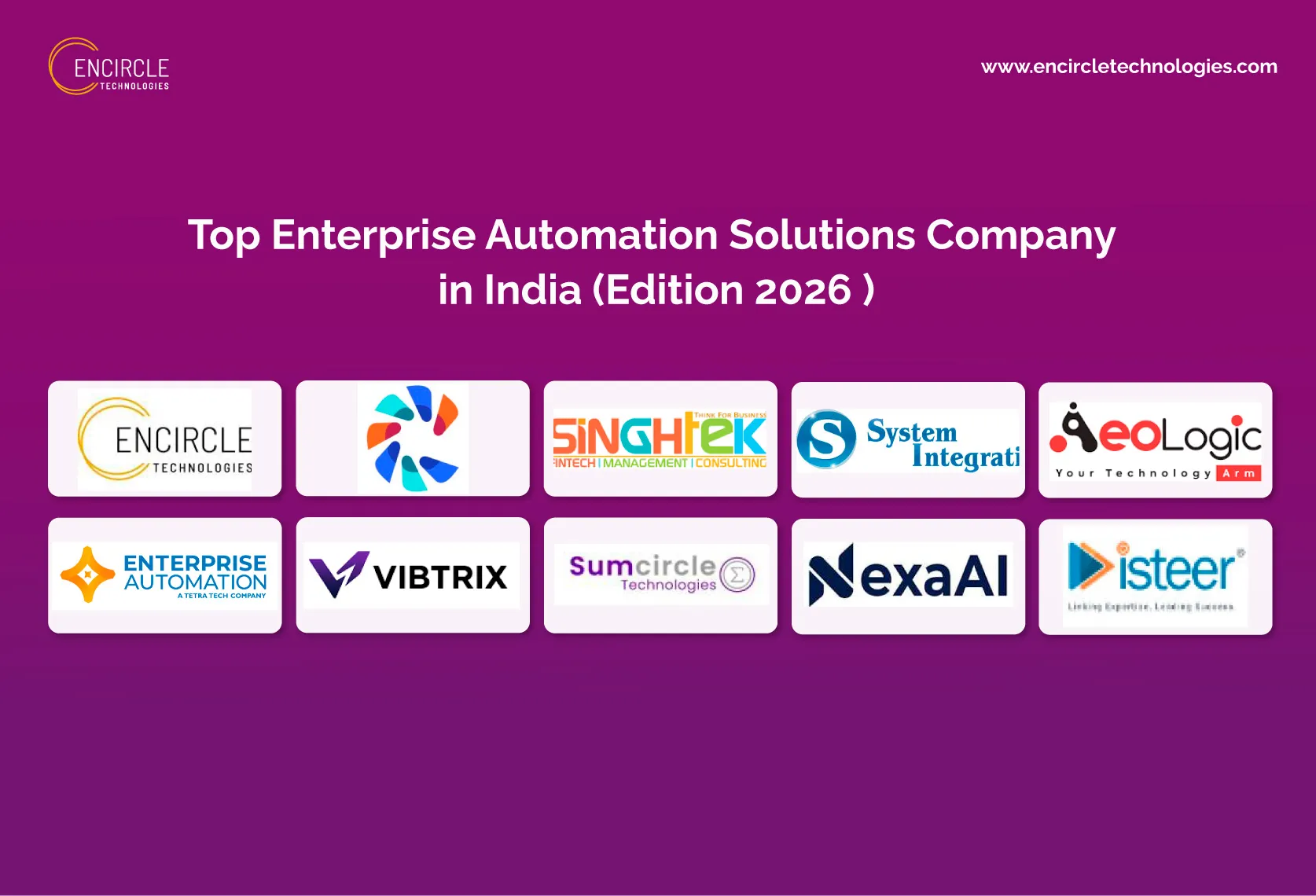
Top Enterprise Automation Solutions Company in India (Edition 2026)
With businesses wanting to speed up their operations, keep costs low, and create great customer experiences, there has never been a better time to leverage the power of workflow automation services. Partnering with a leading enterprise automation solutions company in India ensures businesses implement the right automation strategies to improve operational efficiency, reduce costs, and […]
Read More
18 min read
Business Automation
July 9, 2026
A Complete List of Enterprise Automation Services for Scalable Growth
Business automation integrates technology to automate frequent workflows that involve lead management, invoicing, and user communication activities that demand human intervention. Business automation services allow automated execution of tasks through predefined rules. It reduces the requirement for manual tasks while enhancing precision and maintaining operational efficiency. Business automation allows firms to automate their standard operations […]
Read More
15 min read