


Encircle Technologies is an IT company specialising in the Web and Mobile app development services for all types of businesses; small or large, for all business verticals, across the world. We’re proud to say that our team has worked with some truly incredible partners over a short period of time.

- /
- Blog
- /
- AI Implementation Checklist for Small Businesses: A Step-by-Step Guide
Summarize this blog post with:
Small businesses can use AI to automate repetitive tasks, improve productivity, and make better business decisions. However, limited budgets, technical skills, and data security concerns can make AI adoption challenging. The ideal business automation services can help to overcome the challenges and streamline operations.
Having a structured AI implementation checklist helps businesses plan effectively, select suitable tools, train employees, and monitor performance. A 2025 LinkedIn study found that 95.6% of Indian SMBs were investing in or planning AI adoption, highlighting the growing importance of a clear implementation strategy. A structured approach can help businesses reduce risks, manage resources efficiently, and support sustainable growth.
What Is an AI Implementation Checklist?
A structured AI implementation checklist for businesses helps companies with the effective planning, adoption, and management of AI solutions is called an AI implementation checklist. It describes crucial actions, such as determining business requirements, evaluating readiness, implementing tools, and tracking outcomes. This approach helps small firms reduce risks, manage resources effectively, and improve productivity. It helps to achieve measurable business objectives by allowing organized AI planning.
How to Measure AI Implementation Success
⮞ Track time savings
To find areas for additional automation and efficiency gains, compare the amount of time employees spend on tasks before and after AI adoption.
⮞ Measure cost reductions
Keep an eye on changes in labor prices, resource utilization, and operating expenses to see if AI can cut costs without sacrificing quality.
⮞ Monitor productivity
Monitor task completion, processing speed, and output quality to assess how well AI improves worker productivity and company operations.
⮞ Evaluate customer satisfaction
To determine whether AI improves customer experiences and service quality, gather customer feedback, track satisfaction ratings, and examine response times.
⮞ Calculate AI ROI
To assess profitability and inform future investment choices, weigh the financial advantages of AI against the total costs of deployment and upkeep.
Why Do Small Businesses Need an AI Implementation Checklist?
➥ Reduce adoption risks
Before implementing AI solutions across crucial business functions, a structured checklist helps small firms identify possible obstacles early on, fill in technical gaps, and avoid expensive implementation errors.
Improve productivity.
Employees can save time, improve processes, and concentrate on tasks that provide more company value by using an AI implementation checklist that identifies repetitive tasks and opportunities for automation.
Manage resources.
Small organizations are able to plan workforce needs, allocate resources efficiently, and prioritize important tasks. The appropriate workflow automation services can further help in resource optimization and streamline day-to-day operations.
➥ Ensure data security
A checklist lowers privacy concerns and supports responsible AI adoption by encouraging companies to set up access restrictions, safeguard sensitive data, and adhere to relevant rules.
Measure AI ROI.
Establishing KPIs before implementation allows companies to monitor cost reductions, productivity increases, and operational improvements, which helps assess AI performance and whether investments produce measurable returns.
Also Read: AI Automation Use Cases for Professional Services Firms
12-Step AI Implementation Checklist for Small Businesses
1. Identify Business Challenges and AI Opportunities
To find tasks that take a lot of time or resources, start by going over your current business routines. Look for repetitive tasks that AI could streamline, such as data entry, inventory tracking, customer service, and report creation. Next, rank opportunities according to their predicted benefits, implementation effort, and possible business impact. Instead of implementing technology, concentrate on issues where AI may provide measurable improvements.
2. Define Clear AI Implementation Goals
Determine your company’s goals before making an AI investment. Establish clear objectives, such as lowering operating expenses, raising customer satisfaction, increasing revenue, or streamlining decision-making. Next, establish measurable success indicators such as response times, conversion rates, and saved hours. Make sure your AI goals complement broader company priorities. Setting clear objectives helps small firms in assessing their progress, allocating resources wisely, and figuring out whether their AI investments produce significant returns.
3. Assess Your Business’s AI Readiness
Before implementing AI solutions, assess your company’s preparedness. Examine your current software programs, data management procedures, IT infrastructure, and technical skills. Next, evaluate your staff members’ abilities and determine whether they require more training to use AI tools. Think about possible challenges, such as outdated systems, limited finances, and inadequate technical knowledge. Knowing these gaps allows you to select appropriate technologies and avoid unnecessary expenses during the adoption process.
4. Evaluate Data Quality and Availability
For AI systems to produce valuable outcomes, they require reliable, relevant, and easily accessible data. Start by determining the data sources your company already uses, such as CRM platforms, inventory systems, sales records, and customer databases. Look for errors, duplicates, and missing values. Additionally, check if employees and AI tools can safely access the necessary data. Businesses may provide more reliable results and make more informed decisions by improving data quality prior to adoption.
5. Set a Realistic AI Implementation Budget
Create a realistic budget that takes into consideration both upfront and recurring costs. Software subscriptions, development expenses, system integration, staff training, and infrastructure improvements should all be taken into account. When calculating the overall cost of ownership, don’t forget to account for routine maintenance, security upgrades, and future improvements. Additionally, small enterprises should set aside money for unforeseen implementation-related difficulties. You can choose cost-effective AI solutions, control financial risks, and ensure the project is sustainable as your company expands.
6. Select the Right AI Tools and Technologies
Select AI solutions that meet your available resources and address your unique business needs. Examine options according to features, cost, usability, security, and customer service. Additionally, check if the products work with your current accounting software, communication platforms, CRM, and other company systems. To make sure the system can handle future expansion, take scalability into account. By choosing the right technologies, small firms may avoid unnecessary complexity and adopt AI more practically and economically.
7. Develop an AI Implementation Roadmap
Make a detailed plan outlining the introduction of AI in your company, from preliminary planning to final implementation. Set reasonable deadlines for each task, divide the project into manageable phases, and create realistic milestones. Assign tasks to team members so that everyone is aware of their part in the process. Incorporate evaluation checkpoints, possible hazards, and resource requirements into your plan. A well-organized roadmap improves responsibility, keeps implementation organized, and assists your company in resolving issues before they have an impact on project results.
8. Start With a Small AI Pilot Project
Start with a pilot project rather than spreading AI throughout your entire company right away. Select a simple use case, such as classifying incoming emails, creating reports, or automating customer inquiries. Get input from staff members who utilize the solution after testing it in a safe setting. To determine advantages and disadvantages, compare the outcomes to your initial objectives. Before increasing the use of AI, a successful pilot helps verify your strategy, lower implementation risks, and improve confidence.
9. Ensure AI Security, Privacy, and Compliance
Throughout the AI implementation, business information protection should continue to be a top focus. Determine the types of data your AI technologies gather, manage, and keep, especially private client and employee data. Select systems that have the right encryption, security, and access controls. Make sure your procedures adhere to industry standards and any data protection laws. Establish specific AI usage guidelines to help staff members use the technology responsibly. These safety measures encourage responsible AI use, lower security threats, and safeguard consumer confidence.
10. Train Employees for AI Adoption
Employees must comprehend how AI complements their everyday duties for the technology to be implemented successfully. Give hands-on instruction that explains how to utilize AI tools, analyze their results, and identify any mistakes. Encourage employees to test out authorized applications and provide comments on their experiences. Explain how AI could improve their work rather than just replace current tasks. Ongoing education improves output and promotes long-term adoption within your company.
11. Integrate AI Into Existing Workflows
Integrate AI into company operations where it can have the biggest impact after your pilot project. Connect AI tools with existing systems, including corporate databases, accounting software, CRM platforms, and customer support apps. Thoroughly test integrations to ensure accurate data flow across systems. Automate appropriate chores while maintaining human oversight for critical choices. After deployment, keep an eye on workflows to detect mistakes, incompatibilities, and delays. Employee productivity is increased through effective integration without interfering with crucial company processes.
12. Monitor AI Performance and Optimise Results
After a solution goes live, AI implementation continues. Keep an eye on performance to see if the technology is still helping you achieve your goals. Keep an eye on important performance metrics, including error rates, client satisfaction, processing time, and cost savings. To assess return on investment, compare these outcomes with your original goals. Get feedback from employees, examine results produced by AI, and resolve any new problems. As company needs change, use these insights to expand successful apps, improve procedures, and optimize setups.
Also Read: 15 Business Processes You Can Automate Using AI
Common AI Implementation Mistakes to Avoid
✦ Unclear Business Goals
Time and resources can be wasted when AI is implemented without clear goals. A workflow automation consultant can help in determining appropriate use cases, defining precise KPIs, and coordinating AI projects with measurable company outcomes.
✦ Poor Budget Planning
Budgets for small businesses may be stretched if AI adoption expenses are underestimated. To make sure your investment is cost-effective, factor in software subscriptions, integration, employee training, maintenance, and unexpected costs.
✦ Ignoring Data Security
Ignoring data security can lead to privacy problems and the exposure of private company information. To safeguard consumer information and support responsible AI usage, maintain accurate data, put access limits in place, and adhere to relevant laws.
✦ Lack of Employee Training
Poor training can prevent the use of AI, lower employee confidence, and result in skill gaps. Encourage employees to acquire the skills necessary to use AI technologies efficiently by offering them hands-on training and explaining new workflows.
✦ Skipping Pilot Testing
Without pilot testing, implementing AI may result in mistakes, interfere with workflows, and raise expenses. Before implementing solutions widely, test them on a small scale, assess their effectiveness, get input, and fix any problems.
How Can Small Businesses Prepare for AI Implementation?
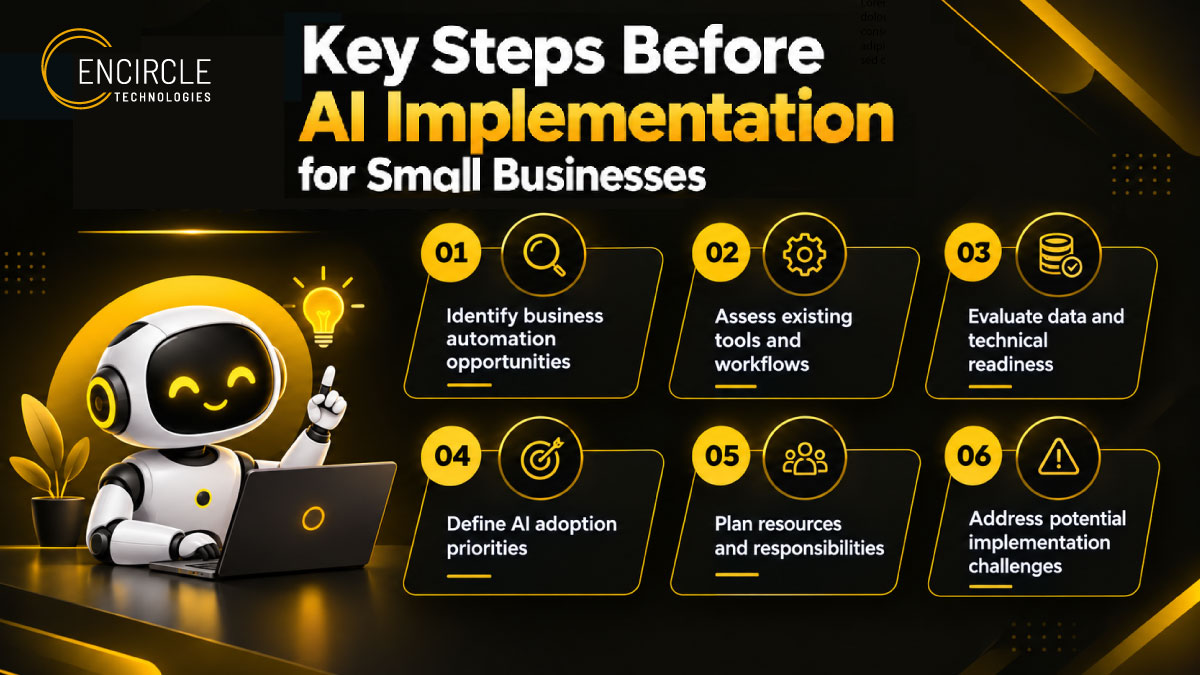
✤ Identify business automation opportunities
Examine daily operations to find time-consuming procedures, repetitive tasks, and activities where AI can increase accuracy and efficiency.
✤ Assess existing tools and workflows
Before implementing AI solutions, assess existing software, business procedures, and systems to find integration opportunities and areas that require improvement.
✤ Evaluate data and technical readiness
To figure out whether your company can support reliable and safe AI adoption, examine data quality, accessibility, infrastructure, and technical capabilities.
✤ Define AI adoption priorities
To concentrate on high-impact opportunities, rank possible AI use cases based on business objectives, expected benefits, implementation complexity, and available resources.
✤ Plan resources and responsibilities
Determine the technical skills required for successful AI adoption, appoint project owners, set a reasonable budget, and assign employee time.
Address potential implementation challenges- To create solutions before implementation starts, identify potential security threats, employee dissatisfaction, integration problems, and financial limits early on.

Ready to Implement AI in Your Small Business?
AI implementation starts with understanding your business goals, measuring AI readiness, and identifying opportunities to improve efficiency. Describe clear goals, allocate resources, and develop a practical strategy for adoption. Collaborate with a business process automation company that helps you choose suitable AI solutions, streamline workflows, and overcome implementation challenges.
With the ideal responsible AI implementation checklist and an expert’s guidance, your small business can adopt AI confidently and achieve sustainable growth.
Tags:
Build a Powerful Web Presence Platform That Drives Sales


Our Recent Articles
AI Automation
October 9, 2026
AI Automation Use Cases for Professional Services Firms
Professional services firms are adopting business automation services to reduce manual work, improve efficiency, and deliver better results. Manual and repetitive tasks like data entry, email handling, and file management can consume significant time and hinder productivity. AI automation is helping firms streamline workflows, optimise resources, improve service delivery, and unlock new growth opportunities. According […]
 Encircle Technologies
Read More
9 min read

AI Automation
April 29, 2026
List of Top AI Automation Company in USA (Edition 2026)
In 2026, the top automation AI companies in the USA are dominated by the major enterprise platforms. These leaders stand out for practical execution and history of developing AI solutions. AI isn’t a future concept, but it will become the backbone of companies in 2026. It decides how businesses function daily. AI schedules work, gives […]
Read More
17 min read

AI
April 20, 2026
Top AI Automation Company in India for Business Process Automation
Find the top AI automation company in India for business process automation. Boost efficiency, cut costs, and scale faster with AI Solutions.
Read More
15 min read