Managing content across websites, apps, and smart devices can be challenging with traditional CMS platforms. A headless CMS greatly streamlines the publishing process across multiple channels, provides more flexibility and boosts performance. Businesses can embrace this trend with professional headless CMS development services and create scalable digital experiences. Let’s take a look at the best headless CMS platforms for 2027.
As businesses increasingly prioritise omnichannel content delivery, the demand for flexible content management solutions continues to grow. According to WP Engine’s State of Headless 2024 report, 73% of surveyed businesses were already using headless architecture, highlighting its growing adoption among organisations.
What Is a Headless CMS Platform?
A headless CMS is a CMS that is designed to be a content repository, without a front-end interface. In contrast to older platforms, there is no pre-built “front end” or “view layer”, that is, the “head” (presentation layer) is separated from the “body” (content database).
In a standard WordPress CMS (Content Management System), your text, images, code and design templates are very hard-coded together in a single system. When you need to redesign your website or come up with a mobile app, you sometimes need to start from scratch. On the other hand, leading headless cms systems store raw material in cloud-based data centers and provide it through tidy APIs to anywhere.

How Do Headless CMS Platforms Work?
Headless CMS development separates content management from the front-end development. Content creators handle content with a backend dashboard and developers create interfaces using frameworks such as React, Next.js and Vue. REST or GraphQL APIs feed digital content to websites, apps, and more. Separate design updates, performance and multi-channel publishing.
How to Choose the Best Headless CMS Platform for Your Business
Prior to investing in headless development services, consider your organization on five reasonable considerations:
⮞ Identify Your Business Requirements
Set main objectives before you start. Do you operate one marketing site, an international e-commerce business or ten regional brand portals? It depends on the weight for a lightweight or enterprise platform.
⮞ Evaluate API and Integration Capabilities
Determine if the platform provides REST and GraphQL APIs, webhooks and native integrations with your current marketing, analytics, and commerce technology.
⮞ Consider Security and Scalability
Look for enterprise essentials like single sign-on (SSO), role-based access control, automatic backups, and guaranteed uptime SLAs.
⮞ Check Content Editing and Management Features
The best CMS will be simple for non-technical editors. Search for live previews, publish date, custom approval process, and localization options.
⮞ Compare Pricing and Maintenance Costs
Consider the free tiers, per-seat user fees, API usage limits, and hosting costs. Open-source platforms eliminate licensing costs, but also need to be managed on your servers, while SaaS options come with managed cloud infrastructure.
Also Read: 10 Headless CMS Migration Mistakes That Put Budget, Timelines, and ROI at Risk
Best Headless CMS Platforms to Consider in 2027
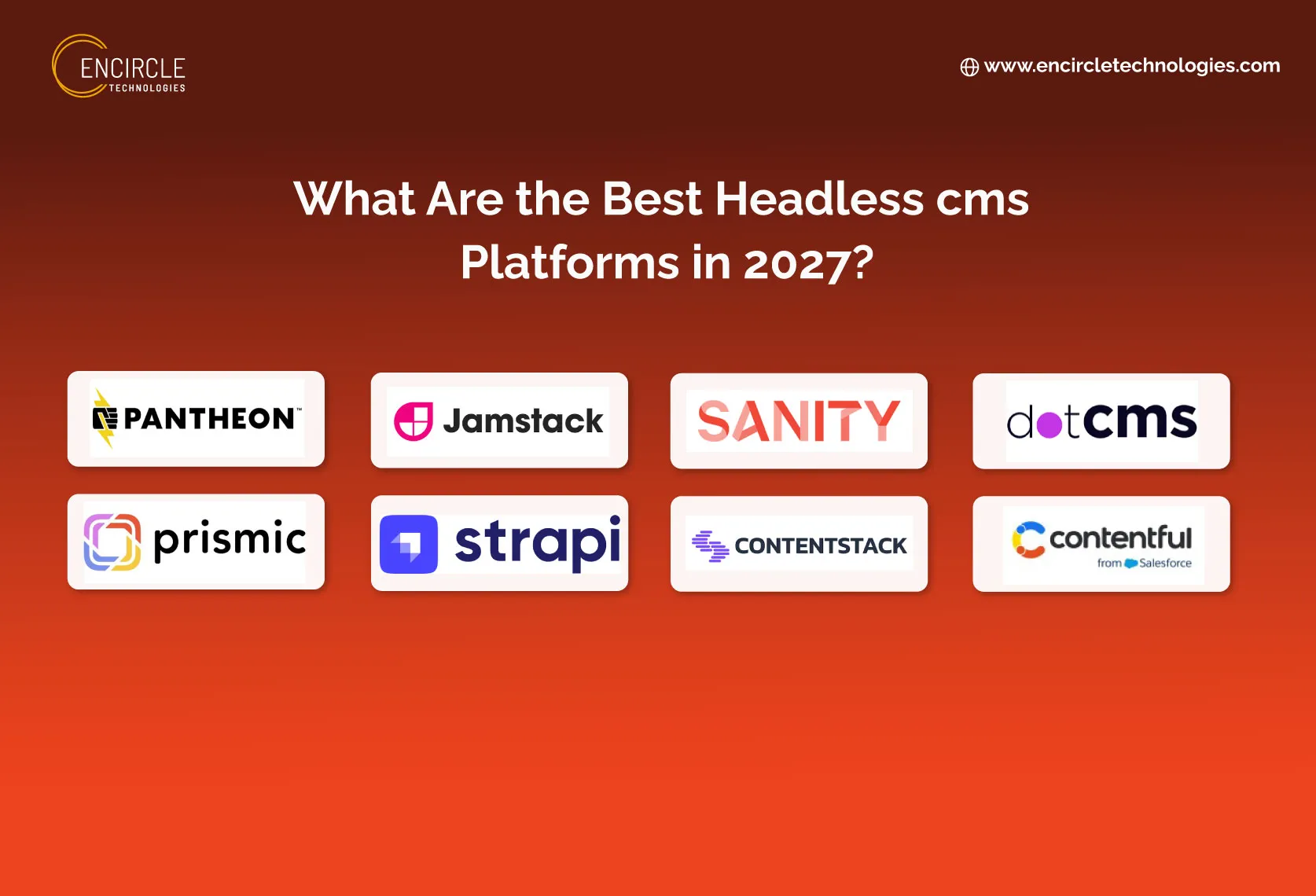
The decision of which most popular headless cms platforms to use is based on the size of your business, the technical requirements, budget, and content management needs. There are eight popular options that you might want to consider in 2027.
1. Pantheon

Pantheon is a WebOps platform that supports both decoupled and Headless CMS platforms. It features cloud hosting, automated deployment workflows and edge caching, making it easier for businesses to handle high-performing websites. It also provides easy testing, collaboration and updates with the development tools, making it ideal for teams working on large digital projects.
2. Jamstack

Jamstack is not a CMS; it’s a new, modern approach to web development. It is a JavaScript-API-based solution that provides pre-rendered markup, making for fast, secure and scalable websites. It supports multiple headless CMS solutions that let developers select their favourite frontend frameworks and content management applications, while improving website performance.
3. Sanity

It is a flexible headless CMS which stores content as structured data, which makes it easy to reuse across different digital channels. Sanity is its flexible, real-time collaborative, content preview editing environment, built on React. AI tools can also enhance content workflows, making them more streamlined and efficient, and developers can tailor content workflows to their specific needs.
4. dotCMS

dotCMS is an enterprise-level, headless CMS for businesses with multiple websites, brands, and digital experiences. It integrates content delivery with visual page building features to give marketers the ability to control content without relying on developers solely. It is ideal for large organisations thanks to its multi-site management, security controls and personalisation technology.
5. Prismic

Prismic enables developers and marketing teams to collaborate in a flexible content management system. It has a Slice Machine that enables developers to build re-usable parts of the website known as Slices. These parts can be utilized by the marketing teams to create landing pages, update the website content, and test changes without being dependent on a constant developer presence.
6. Strapi

Strapi is an open-source headless CMS that runs on Node.js and provides developers with a lot of control over content structures and API. It supports REST and GraphQL, custom Plugins and flexible integration with Frontend Frameworks. Strapi can be self-hosted or provided as a cloud service, making it an ideal solution for startups and enterprises looking for a flexible content management solution.
7. Contentstack

Contentstack is an enterprise-level, composable CMS designed for handling high volumes of content in several channels. It provides role-based access control, localization, third-party business application integrations, and workflow automation. The visual editing and personalization features enable marketing teams to maintain a consistent digital experience across various markets, even if they’re running campaigns.
8. Contentful

Contentful is a popular headless CMS that is renowned for its extensive integration and structured content management capabilities. It enables businesses to produce content once and share it on various websites, mobile apps, and other digital platforms. Its powerful content modeling capabilities, localization, APIs, and enterprise capabilities make it a good option for enterprises with complex digital experiences and large volumes.
Key Benefits of Using Headless CMS Platforms
Working with a competent headless cms development agency offers huge technical and business benefits over the legacy systems, such as:
✦ Flexible Frontend Development
There is no need to stick to a theme or an old programming language when developing them. They can utilize the most recent and advanced front-end tools that are offered to them to enable them to build customizable user encounters.
✦ Faster Website Performance
Headless websites deliver static content and lightweight API responses to all global content delivery networks, which results in much faster loads and higher Core Web Vitals.
✦ Omnichannel Content Delivery
Write once and publish everywhere. A single dashboard for all your content to be consumed by web browsers, apps on iOS and Android, smartwatches, and AI interfaces.
✦ Improved Scalability
The Frontend and Backend are operated separately therefore a sudden surge in traffic on your site will not affect your editorial dashboard or database.
✦ Better Developer Experience
Teams can develop, test and release new features twice as fast with clean documentation, up-to-date SDKs, and deployment pipelines based on Git.
✦ Easier Third-Party Integrations
API-first design allows you to easily integrate your CMS with eCommerce platforms such as Shopify, CRM software, analytics platforms, and AI search engines.
Also Read: Headless CMS Migration: Step-by-Step Guide for a Smooth Transition
Headless CMS Platforms: Key Features
As you are making the short list of top headless cms platforms and narrowing down on headless cms development, ensure your list has these key features:
➥ API Support and Flexibility:
REST and GraphQL endpoints are fast, well-documented and come with edge caching for global delivery with minimal latency.
➥ Content Modelling Capabilities:
Custom fields, reusable content blocks, and relational schemas to ensure that your data remains clean and well-structured.
➥ Hosting and deployment options:
Choice of fully managed SaaS cloud hosting, self-hosted servers or hybrid environments.
➥ Customisation and Integrations:
Extensible admin interfaces, custom plugins, webhooks that seamlessly integrate with external business software.
➥ Security and Access Control:
Granular user permission, audit logs, two-factor authentication, and decoupled architecture to minimize attack surfaces.
➥ Pricing and Scalability:
Clear usage tiers with seamless scalability for increased traffic, API usage, and team size.
Ready to Choose the Right Headless CMS for Your Business?
Choosing the right content foundation is one of the best investments you can make for long-term digital agility. In 2027, the number of interaction points your customers can engage with is growing, and the concept of one-size-fits-all platforms is stalling your marketing velocity and technological advancements. There are many headless cms options for comparison, but when you compare them with your editorial requirements, traffic volumes, and integration requirements, you’re able to create a digital presence which will be ready for the future.
Having a knowledgeable headless cms development company on your side allows you to rest easy knowing your site’s transition is smooth, safe, and optimized for your specific objectives. From scratch setup or migration from an existing system, a trusted headless development company or headless cms development agency can handle the architecture design, API integrations, and frontend engineering.
Contact a specialized headless cms development company today to learn more about end-to-end headless cms development services and headless development services that future-proof your digital growth.







 Encircle Technologies