


Encircle Technologies is an IT company specialising in the Web and Mobile app development services for all types of businesses; small or large, for all business verticals, across the world. We’re proud to say that our team has worked with some truly incredible partners over a short period of time.

- /
- Blog
- /
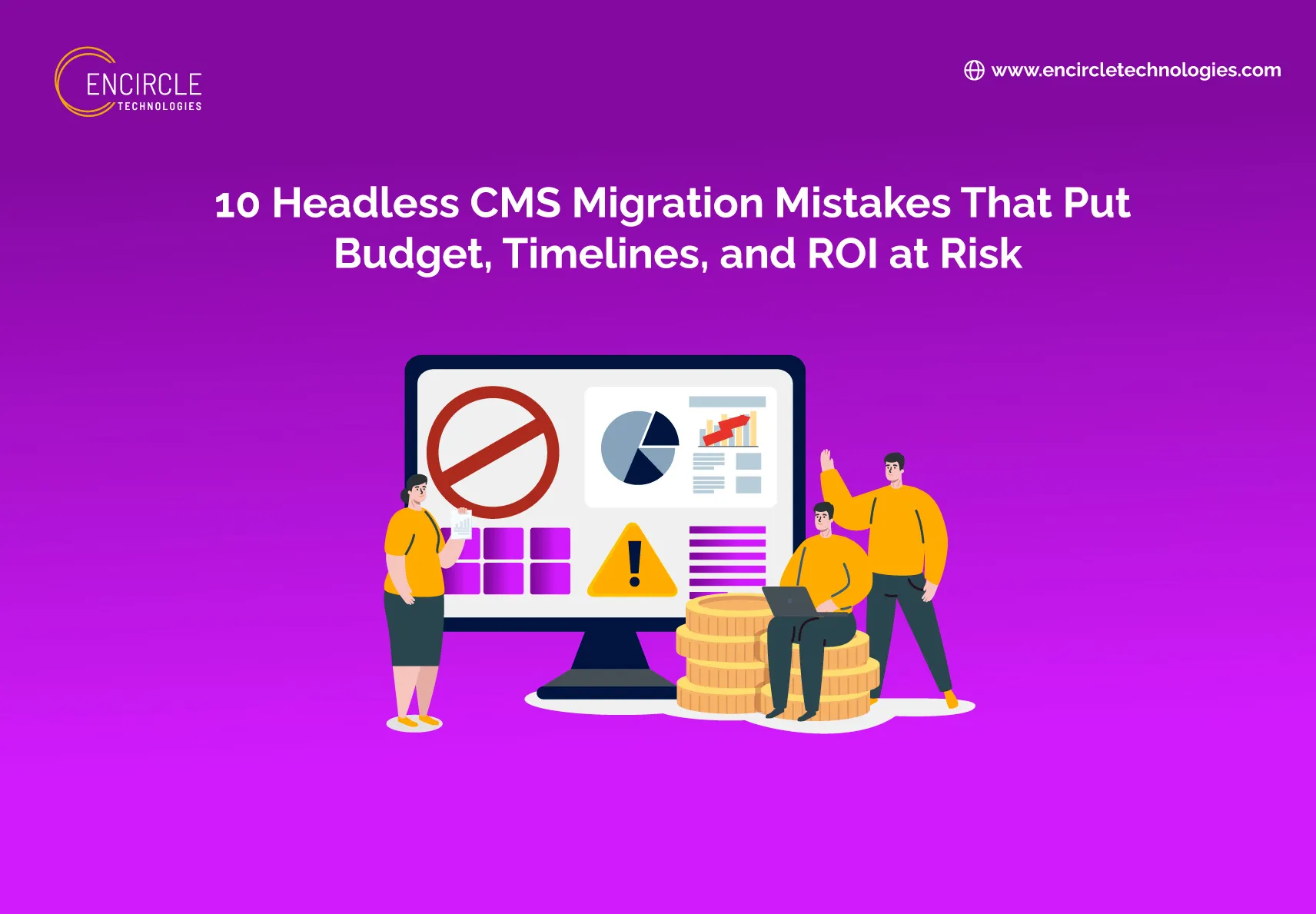
- 10 Headless CMS Migration Mistakes That Put Budget, Timelines, and ROI at Risk

Summarize this blog post with:
Headless CMS migration includes moving a traditional CMS to a headless architecture that separates the content backend from the presentation layer. Most businesses are making this shift to improve flexibility, develop a better digital experience, and deliver content across various channels. With the best headless CMS development services, organizations can develop scalable sites, streamline content management, and allow developers to choose frontend technologies.
However, migration involves more than moving existing content. Poor planning, unexpected integration issues, missed SEO requirements, and insufficient testing can increase costs and delay project timelines. According to the 2025 DevOps Migration Index by CloudBees, enterprise platform migration projects exceeded their budgets by an average of 18%, resulting in approximately $315,000 in additional costs per project.
Why Headless CMS Migration Requires Careful Planning
Businesses may manage technical complexity, keep expenses under control, and prevent unnecessary delays with careful planning. Before starting the migration, evaluate the business needs, available resources, finances, and schedules. A methodical approach taken by CMS development company in India ensures that the new CMS minimizes operational issues while supporting long-term objectives.
✦ Key Factors That Influence Migration Success
Website complexity, content volume, frontend and CMS options, third-party integrations, content quality, migration scope, team experience, and available funds all affect how well a migration goes. Businesses may choose appropriate technologies, distribute resources efficiently, and set reasonable project objectives by evaluating these issues early on.

How to Plan a Successful Headless CMS Migration
To plan your migration, reduce risks, and achieve your business objectives, follow these steps.
• Examine the functionality, content, integrations, and technical limitations.
• Establish precise goals, project schedules, and reasonable cost projections.
• Consider scalability, security, adaptability, and integration requirements while evaluating platforms.
• To plan deployment and handle technical issues, collaborate with a reputable headless CMS development agency.
• To safeguard organic visibility, organize content, map URLs, and set up redirects.
• Verify user experience, security, speed, and functionality.
• To find areas for improvement, monitor traffic, conversions, errors, and performance.
Also Read: Headless CMS Migration: Step-by-Step Guide for a Smooth Transition
Headless CMS Migration Mistakes That Put Budget, Timelines, and ROI at Risk

1. Migrating Without a Clear Business Strategy
Without a well-defined business plan, a headless CMS migration may result in unnecessary costs, missed deadlines, and poor results. Companies could concentrate on technological skills without determining the issues they wish to address. Teams may find it difficult to assign resources, prioritize features, and measure performance in the absence of clear objectives. The overall return on investment may be lowered by this mismatch between technology and business requirements.
How to avoid it:
Prior to choosing a platform, establish quantifiable migration goals. Determine key performance indicators (KPIs), such as operational expenses, website performance, and the speed at which information is published. Make sure the migration produces significant outcomes by coordinating technical decisions with long-term business objectives.
2. Choosing the Wrong Headless CMS Platform
Scalability problems, integration difficulties, and unexpected development expenses can arise from selecting an inappropriate headless CMS platform. Some companies put popular features or initial pricing ahead of their true needs. A platform that needs a lot of customization or lacks key features may require more maintenance. Similarly, connections with current marketing, analytics, and e-commerce systems may be made more difficult by a lack of integration possibilities.
How to avoid it:
Compare platforms to certain technical and business requirements. Examine costs, security, scalability, API capabilities, integration choices, and developer experience. Take into account the costs of both initial deployment and ongoing maintenance. Involve decision-makers, content editors, and developers in the selection process to make sure the platform supports ongoing company operations and future expansion.
3. Underestimating Migration Scope and Costs
Migrating content to a new platform is only one aspect of headless CMS migrations. When estimating project costs, businesses could ignore custom programming, API integrations, content rearrangement, testing, and employee training. Budgets may be stretched, and launch dates may be postponed due to these ignored criteria. Teams may be forced to make costly adjustments midway through development as a result of inadequate planning, which would increase project complexity and lower overall productivity.
How to avoid it:
Before estimating the project, do a thorough technical and content audit. Determine the needs for content migration, integration, custom functionality, and current dependencies. To reduce unforeseen expenses and maintain implementation on schedule, divide the project into clearly defined phases, assign responsibilities, and set reasonable deadlines.
4. Ignoring Content Modelling and Content Architecture
A headless CMS may be challenging to grow and administer due to poor content modelling. Businesses may bring over inconsistent fields, duplicate entries, and rigid content types when they move current content without examining its structure. These issues may make it more difficult to publish content on websites, mobile apps, and other digital platforms. Additionally, an inappropriate architecture may make future content updates more challenging.
How to avoid it:
Before beginning the migration, create reusable, structured content models. Define fields, relationships, validation criteria, and content types according to business needs. Involve developers and content editors in architectural choices to achieve a balance between technical requirements and editorial flexibility. To ensure uniformity, establish naming conventions and documentation. A well-planned content architecture allows more effective omnichannel content delivery, easier publishing, and easier management.
5. Overlooking SEO During Migration
The biggest headless CMS migration mistakes are neglecting SEO that can damage organic visibility, lower website traffic, and have an impact on conversions. Search engines may not be able to comprehend a new website due to URL structure changes, missing metadata, broken internal links, and incorrectly configured redirects. Additionally, companies might ignore indexing settings, XML sitemaps, canonical tags, and structured data. Even though the updated website provides a better user experience, these problems may affect search performance.
How to avoid it:
Prior to migration, examine current URLs, ranks, backlinks, and organic traffic. When addresses change, use the appropriate 301 redirects and try to keep critical URLs accessible. Save structured data, canonical tags, and important metadata. As necessary, update the robots.txt settings, internal links, and XML sitemaps. Track indexing, rankings, traffic, and website performance after launch to quickly find and fix SEO problems.
6. Neglecting API Integrations and Third-Party Dependencies
To integrate content with websites, apps, and other digital systems, a headless CMS uses APIs.After migration, neglecting current integrations can interfere with crucial company activities. For example, e-commerce functionality, marketing automation, analytics tracking, and client data synchronization may all be impacted by incompatible APIs. Inadequate error handling and undocumented dependencies can make troubleshooting more difficult, cause deployment delays, and raise maintenance expenses after the new system goes live.
How to avoid it:
Prior to developing, map all current integrations and third-party dependencies. Examine data formats, rate limits, authentication requirements, and API compatibility. Instead of waiting until launch, test important data flows early in the project. To rapidly detect issues, use proper error handling, logging, and monitoring. To ensure business continuity in the event that external services are disrupted, document integration requirements and set up backup plans.
7. Underestimating Content Migration and Data Quality Issues
When massive amounts of content are migrated without enough planning, broken links, missing assets, duplicate entries, and inconsistent formatting may be introduced. Additionally, incomplete or out-of-date content can migrate to the new CMS, requiring unnecessary upkeep. Although improperly mapped fields or unsupported formats may result in errors, automated migration scripts can speed up transfers. The accuracy of published material, user experience, and editing efficiency can all be impacted by these problems.
How to avoid it:
Before migrating, audit current content and eliminate any out-of-date, unnecessary content. When necessary, automate repetitive procedures and map source fields to the new CMS structure. Verify migrated text, photos, formatting, links, and metadata using methodical inspections. Involve content teams in the evaluation of key assets and representative pages. To minimize interruption and guarantee that the new platform begins with trustworthy, well-organized material, give priority to high-value content.
8. Skipping Testing and Quality Assurance
Functional, security, accessibility, and performance problems may find their way into production due to inadequate testing. Under pressure to meet deadlines, businesses may prioritize basic page rendering over forms, search capabilities, API responses, mobile responsiveness, and browser compatibility. These issues can cause user frustration, interfere with conversions, and necessitate expensive emergency solutions.
How to avoid it:
Make a thorough testing checklist that addresses security, functionality, performance, accessibility, and regression testing. Before deploying, use staging environments to find problems. Test forms, navigation, content rendering, responsive layouts, and API integrations on the appropriate devices and browsers. Verify that business needs are satisfied by conducting user acceptance testing with stakeholders. Before launching, fix any serious flaws, and after deployment, keep an eye on the website.
9. Overlooking Team Training and Change Management
Teams’ methods for producing, approving, managing, and publishing content are frequently changed by a headless CMS. Content editors may find it difficult to use new interfaces, organized content models, and publishing procedures if they are not properly trained. Additionally, maintaining new connectors or controlling access may be challenging for developers. Inadequate communication and ambiguous roles can hinder adoption, lead to more operational mistakes, and keep companies from reaping the full rewards of their new CMS investment.
How to avoid it:
Before launch, give content editors, developers, marketers, and administrators role-specific training. Write documentation on permissions, content models, publishing methods, and troubleshooting techniques. To avoid misunderstandings, clearly clarify ownership and approval procedures. Employees should be included in the migration process so they may provide comments and understand the upcoming changes. After launch, provide continuing assistance to close knowledge gaps, promote trust, and improve operational effectiveness.
10. Launching Without a Post-Migration Plan
Businesses may be at risk of unnecessary hazards if launch day is viewed as the completion of a headless CMS conversion. After deployment, the website may be impacted by undetected technical faults, API malfunctions, indexing issues, and performance concerns. Resolving significant issues may become more challenging in the absence of reliable backups or a rollback plan. Inadequate post-launch monitoring can also make it more difficult for teams to find ways to improve performance and return on investment.
How to avoid it:
Create a rollback plan, keep reliable backups, and assign roles for resolving post-launch issues. After implementation, keep a careful eye on website metrics, search visibility, conversions, API performance, and error logs. Compare the outcomes to the KPIs set before the migration. To manage new problems, plan frequent technical evaluations and performance upgrades. Maintaining website reliability, safeguarding business results, and optimizing long-term value from the new CMS are all made possible by ongoing monitoring and improvement.
Also Read: Headless CMS for Enterprise: Benefits, Features, and Use Cases
Headless CMS Migration Checklist
⮞ Set specific goals and quantifiable success metrics to avoid CMS migration problems.
⮞ Take development, testing, training, and maintenance expenses into consideration.
⮞ Determine dependencies, third-party systems, and out-of-date content.
⮞ Make fields and content kinds organized and reusable.
⮞ Prevent broken links and maintain SEO value. Verify functionality and get employees ready to use the new system.
With the assistance of a reliable headless CMS development team, monitor performance, traffic, mistakes, and conversions.

Turn Your Headless CMS Migration Challenges into Business Growth
Avoiding the above-discussed common CMS migration problems can increase costs, delay launches, and reduce ROI. A successful migration should deliver measurable business values through better scalability, efficient workflows, improved experiences and long-term growth.
Partnering with a reliable headless CMS development company allows firms to plan strategically. It helps businesses structure their content effectively, improve SEO performance, and allow teams to adapt.
Tags:
Build a Powerful Web Presence Platform That Drives Sales


Our Recent Articles
Headless CMS
September 28, 2026
Headless CMS Migration: Step-by-Step Guide for a Smooth Transition
Traditional CMS platforms are struggling to match modern digital demands. Organizations are moving beyond traditional CMS platforms to achieve better flexibility, faster digital delivery, and a consistent experience across sites, mobile apps, and other channels. A headless CMS migration system separates content management from presentation, allowing teams flexibility to develop quick and more customized digital […]
 Encircle Technologies
Read More
9 min read
Headless CMS
August 5, 2026
What to Look for in a White Label Development Partner
Multiple marketing agencies prefer White Label as the popular outsourcing form, since it helps them match their client demands. The upgrades in digital marketing have made white label development agencies popular. White label marketing is the ultimate way of assisting the best website development company in India to offer quality services to their clients. It […]
Read More
15 min read
Headless CMS
July 27, 2026
Headless CMS Cost in 2026: A Complete Pricing Guide
For any organization, choosing the right CMS is a crucial decision. Headless CMS development services enable businesses to create quicker websites, enhance user experience, and distribute content throughout various platforms. When beginning, many businesses ask: What does headless CMS cost? and how much does a headless CMS cost? The overall headless CMS expenses rely on […]
Read More
14 min read